
Cape Smokey
 Ingonish, Nova Scotia$$
About this mountain
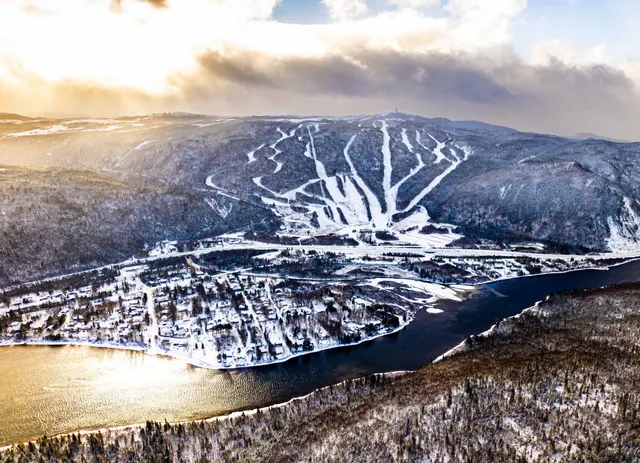
Cape Smokey Ski Club opened in 1972 and has operated as a community-oriented hill on Cape Breton Island ever since. It sits within Cape Breton Highlands National Park, which shapes both its character and its operating context. The resort has long been known among Maritime skiers as an accessible, no-frills destination that offers genuine vertical for the region, and it draws a loyal local following from across Cape Breton and beyond. Its location on the eastern edge of the island, above the Cabot Trail and the Atlantic, gives it a distinct setting that few ski areas in eastern Canada can match.
The mountain rises from a base elevation of 50 feet to a summit of 1,050 feet, delivering 1,000 feet of vertical across 80 skiable acres served by two lifts. The longest run stretches 1.5 miles, rewarding skiers who work top to bottom. Average annual snowfall sits around 100 inches. The terrain suits intermediate and advanced skiers reasonably well, with the vertical and pitch offering more challenge than many comparable Maritime hills. Access runs along the Cabot Trail through the community of Ingonish, making the drive itself a notable part of the experience, particularly in clear winter conditions.
Rankings
Where Cape Smokey places by community score.
Read: Best Resorts in North America →Conditions
Snow reliability
From 20 seasons of snowfall history, matched to the published annual average
Reliability
52/100 · Fairly reliable
More reliable than 40% of mountains
Best weeks
Jan 24–Feb 13
Mid-season dry spellThe share of past seasons with a stretch of 14 days or more in a row with no real new snow (under 1 cm, about half an inch, a day), in the heart of the season: mid-December to mid-March (mid-June to mid-September in the Southern Hemisphere).
0% of years
Fewer dry spells than 93% of mountains
Chance of a 6"+ day, by week
Tap a weekHover a week
Powder quality
How often the snow falls light and dry, from 20 seasons of hourly weather
Light and dry
40%
of its snow falls below 28°F
Region rank
#124 in Eastern Canada
of 125 mountains
Province rank
#3 in Nova Scotia
of 4 mountains
Snow by type
Cold smoke7%
Under 20°F
Dry33%
20–28°F
Dense41%
28–32°F
Wet18%
Over 32°F
Light and dry, compared
Mountain
Vertical drop
1,000 ft
Base elevation
50 ft
Peak elevation
1,050 ft
Size (acres)
80
Total lifts
2
Longest run
1.5 mi
Annual snowfall
100"
Total trails
16
Terrain parks
0
Sun & shade
Mostly north-facing: holds snow well, cold in January.
Which runs are sunny, hour by hour →Trail breakdown
All lifts & trailsMountain DNA
Compare this mountain →How Cape Smokey ranks on each trait against every mountain on Slope Vaults. Dashed line: the median mountain.
Known for steeps. Closest match: Mansfield Ski Club (87% alike).
- Size
- Vertical
- Snow
- Reliability
- Steeps
- Cruisers
- Value
Reviews
What users say
No reviews yet
Be the first to say what it’s like.
Nearby
Getting there
The closest major airport is Halifax Stanfield International Airport (YHZ), roughly a 3.5-hour drive northeast along the Trans-Canada Highway (Highway 105) and the Cabot Trail. Sydney's J.A. Douglas McCurdy Airport (YQY) is the nearer regional option at approximately one hour away, though flight connections there are limited. The Cabot Trail approach to Cape Smokey is scenic but mountainous, and sections can close or become hazardous during winter storms, so checking road conditions before departure is advisable.
There is no dedicated ski shuttle service to the hill. Most visitors base themselves in Ingonish itself or in nearby Baddeck, roughly 90 minutes away, which offers broader accommodation and dining options. A personal vehicle is effectively essential for reaching the resort and navigating Cape Breton Island during a ski trip.
While you’re there
Ingonish is a small, seasonal community, so dining and après options are limited compared to larger resort towns. The Keltic Lodge at the Highlands is the area's most established property, offering dining and accommodation within Cape Breton Highlands National Park, though it operates on a seasonal schedule. Visitors should confirm what's open before arriving, as many local businesses close or reduce hours outside peak seasons.
Beyond skiing, the surrounding Cape Breton Highlands National Park provides compelling reasons to stay. The Cabot Trail runs directly through the area, offering dramatic coastal scenery year-round. Cross-country skiing and snowshoeing trails are accessible nearby, and the rugged Atlantic coastline makes for striking winter walks even when conditions aren't suited to the mountain.
Mountains like this
Matched on size, snow, terrain and more