Hakuba Cortina
 Toyama, Nagano$$
About this mountain
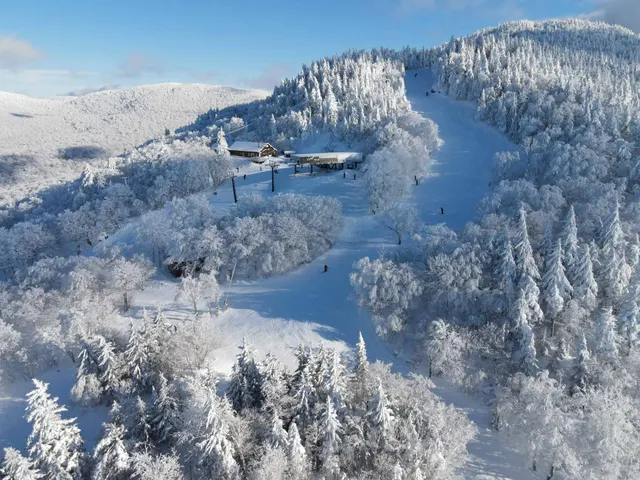
Hakuba Cortina opened in 1967 and has built a loyal following over the decades as one of the snowiest resorts in the Hakuba Valley. Sitting on the border of Nagano and Niigata prefectures, it receives some of the heaviest snowfall in the region, averaging around 330 inches per season, a figure that has made it a consistent destination for powder hunters from across Japan and abroad. The resort became accessible to international visitors more readily after joining the Epic Pass network, which linked it to a global audience without requiring a separate lift ticket purchase.
The mountain offers 12 kilometers of pistes served by six lifts, with a vertical drop of 1,913 feet between a base elevation of 2,651 feet and a summit of 4,564 feet. The terrain leans toward beginner and intermediate skiers, with wide groomed runs descending through forest, though the consistent snow accumulation means off-piste conditions alongside the trails are frequently good. The resort is compact and relatively quiet compared to larger Hakuba neighbors like Happo-One, which suits those who prefer a more relaxed atmosphere. Access from Hakuba village is straightforward, and the smaller scale means lift lines are rarely a significant issue.
Rankings
Where Hakuba Cortina places by community score.
Conditions
Snow reliability
From 20 seasons of snowfall history, matched to the published annual average
Reliability
84/100 · Very reliable
More reliable than 93% of mountains
Best weeks
Dec 27–Jan 16
Mid-season dry spellThe share of past seasons with a stretch of 14 days or more in a row with no real new snow (under 1 cm, about half an inch, a day), in the heart of the season: mid-December to mid-March (mid-June to mid-September in the Southern Hemisphere).
0% of years
Fewer dry spells than 93% of mountains
Chance of a 6"+ day, by week
Tap a weekHover a week
Powder quality
How often the snow falls light and dry, from 20 seasons of hourly weather
Light and dry
64%
of its snow falls below 28°F
Region rank
#40 in Honshu
of 129 mountains
Country rank
#51 in Japan
of 141 mountains
Snow by type
Cold smoke23%
Under 20°F
Dry41%
20–28°F
Dense25%
28–32°F
Wet11%
Over 32°F
Light and dry, compared
Mountain
Vertical drop
1,913 ft
Base elevation
2,651 ft
Peak elevation
4,564 ft
Total lifts
6
Annual snowfall
330"
Total trails
17
Pistes
7 mi
Terrain parks
–
Sun & shade
Mostly south-facing: sunny and warmer. Snow softens early and gets heavy by afternoon in March.
Which runs are sunny, hour by hour →Trail breakdown
All lifts & trailsTrail and lift data from OpenSkiData / OpenSkiMap.org, © OpenStreetMap contributors (ODbL), Skimap.org, Who’s On First, © Mapterhorn.
Mountain DNA
Compare this mountain →How Hakuba Cortina ranks on each trait against every mountain on Slope Vaults. Dashed line: the median mountain.
Known for reliability and snow. Closest match: Jay Peak (86% alike).
- Size
- Vertical
- Snow
- Reliability
- Steeps
- Cruisers
- Value
Reviews
What users say
No reviews yet
Be the first to say what it’s like.
Nearby
Getting there
Matsumoto Airport (MMJ) is the closest commercial airport, roughly 90 minutes by road, though its domestic route network is limited. Most international visitors fly into Nagoya Centrair (NGO) or Osaka Kansai (KIX), each around three to four hours away by a combination of bullet train and local transfer, or into Tokyo Narita or Haneda and connect via the Hokuriku Shinkansen to Hakuba.
The resort sits near the border of Nagano and Toyama prefectures, accessed via narrow mountain roads that can close during heavy snowfall, so carrying chains or renting a four-wheel-drive vehicle is advisable. Most visitors base themselves in Hakuba village, roughly 20 minutes south, where accommodation, restaurants, and onward bus connections are concentrated. Alpico and other regional bus operators run seasonal shuttle services linking Hakuba station with the resort.
While you’re there
Hakuba Cortina sits within the broader Hakuba Valley, and the nearest concentration of restaurants and bars is in Hakuba village, roughly 20 minutes away by car or shuttle. The village has a well-established après scene built around the large international community that has settled in the area, with izakayas, ramen shops, and casual Western-style bars spread along the main strip. Echoland and the central Hakuba township offer supermarkets, local eateries, and izakayas suited to post-ski evenings on a budget.
Beyond skiing, the Hakuba area supports snowshoeing and backcountry touring in the surrounding Otari mountains, and the valley's onsen culture is worth pursuing, several local bathhouses offer hot-spring soaks that suit tired legs well. The nearby Tsugaike and Norikura highland areas provide quieter snowshoe trails away from the groomed runs.
Mountains like this
Matched on size, snow, terrain and more