
Sugarbush
 Warren, Vermont$$$$
About this mountain
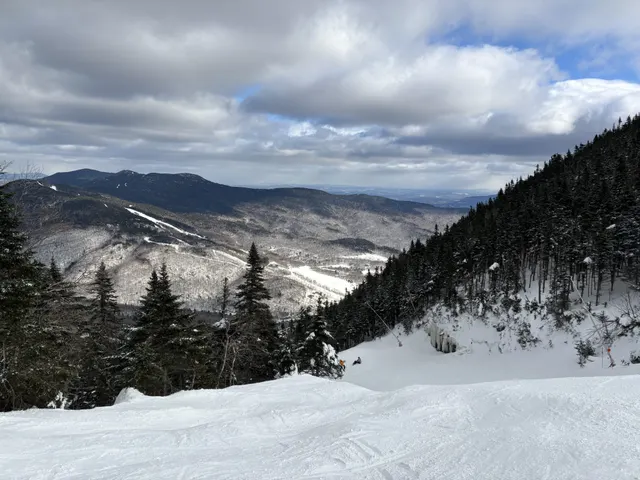
Sugarbush opened in 1958 and quickly developed a reputation as one of the more sophisticated destinations in the East, drawing a cosmopolitan crowd that earned the area the nickname "Mascara Mountain" in its early decades. The resort is composed of two connected mountains, Lincoln Peak and Mount Ellen, linked by a long interconnect lift. Over the decades it has changed ownership several times before landing with Alterra Mountain Company, which has made it part of the Ikon Pass. It has hosted World Cup racing events and is regarded seriously by experienced skiers looking for genuine challenge in Vermont.
The terrain spans 581 acres with 2,600 feet of vertical from a base of 1,483 feet to a summit of 4,083 feet. Lincoln Peak holds much of the expert terrain, including the steep pitches of the Castlerock area, which operates on a more limited schedule and is prized for its natural snow character. Runs like Stein's Run and Organgrinder are well known among regular visitors. The longest run stretches 2.6 miles, giving intermediate skiers room to move. With 269 inches of average annual snowfall and 16 lifts across the two peaks, the resort suits a wide range of ability levels, though its reputation skews toward skiers who want genuine pitch rather than groomed cruising.
Rankings
Where Sugarbush places by community score.
Read: Best Resorts in Vermont →Conditions
Snow reliability
From 20 seasons of snowfall history, matched to the published annual average
Reliability
76/100 · Reliable
More reliable than 87% of mountains
Best weeks
Feb 7–27
Mid-season dry spellThe share of past seasons with a stretch of 14 days or more in a row with no real new snow (under 1 cm, about half an inch, a day), in the heart of the season: mid-December to mid-March (mid-June to mid-September in the Southern Hemisphere).
15% of years
Fewer dry spells than 85% of mountains
Chance of a 6"+ day, by week
Tap a weekHover a week
Powder quality
How often the snow falls light and dry, from 20 seasons of hourly weather
Light and dry
62%
of its snow falls below 28°F
Region rank
#16 in the Northeast U.S.
of 120 mountains
State rank
#9 in Vermont
of 22 mountains
Snow by type
Cold smoke25%
Under 20°F
Dry37%
20–28°F
Dense29%
28–32°F
Wet9%
Over 32°F
Light and dry, compared
Mountain
Vertical drop
2,600 ft
Base elevation
1,483 ft
Peak elevation
4,083 ft
Size (acres)
581
Total lifts
16
Longest run
2.6 mi
Annual snowfall
269"
Total trails
116
Terrain parks
5
Sun & shade
Mostly northeast-facing: holds snow well, cold in January.
Which runs are sunny, hour by hour →Trail breakdown
All lifts & trailsMountain DNA
Compare this mountain →How Sugarbush ranks on each trait against every mountain on Slope Vaults. Dashed line: the median mountain.
Known for reliability and snow. Closest match: Aspen Mountain (85% alike).
- Size
- Vertical
- Snow
- Reliability
- Steeps
- Cruisers
- Value
Reviews
What users say
No reviews yet
Be the first to say what it’s like.
Nearby
Getting there
The closest major airport is Burlington International Airport (BTV), roughly 45 minutes to an hour from the resort under normal conditions. Boston Logan (BOS) is a common alternative for travelers flying into the region, with a drive of around three to three and a half hours depending on traffic. Manchester-Boston Regional (MHT) in New Hampshire is a similar distance.
Access is primarily via Route 100, which runs through the Mad River Valley and is generally reliable in winter, though heavy snowfall can slow travel. Most visitors stay in the nearby towns of Warren and Waitsfield, both a short drive from the base. Montpelier, about 35 minutes away, offers additional lodging options. A free local shuttle connects villages in the Mad River Valley to the mountain on select days.
While you’re there
The base village at Lincoln Peak has a handful of dining and après options, and Castlerock Pub is a reliable stop for post-run beers and pub food. The nearby town of Waitsfield, about ten minutes down the valley, offers a more varied scene, local restaurants, cafés, and the Mad River Glen co-op area adds to the broader regional character. The Mad River Valley is a tight-knit community worth exploring on foot.
Off the slopes, snowshoeing and cross-country skiing are accessible nearby, and the valley has independent shops and art spaces worth a browse. The drive along Route 100 is scenic in winter, and several inns offer spa facilities, a reasonable option after a long day on the mountain.
Mountains like this
Matched on size, snow, terrain and more