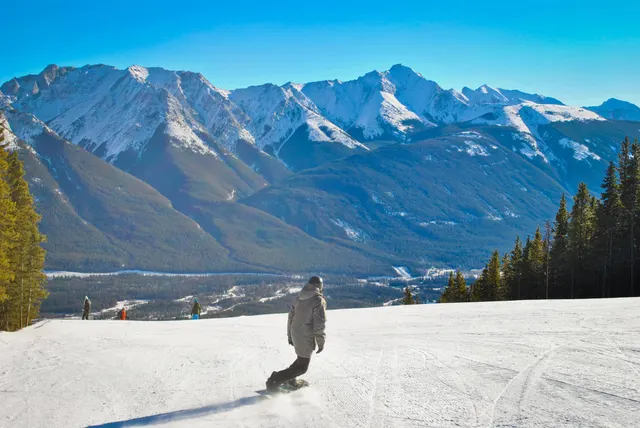
Coronet Peak, Otago Region$$
Coronet Peak opened in 1947, making it one of the oldest ski areas in New Zealand and the oldest in the Queenstown region. Operated by NZSki, it has built a reputation as a reliable, well-groomed destination that draws both recreational skiers and competitive racers. The mountain has hosted numerous national and international racing events over the decades and serves as a primary training ground for New Zealand's alpine ski team. Its proximity to Queenstown, roughly 18 kilometres by road, has made it a natural choice for visitors combining skiing with the wider range of activities the resort town offers.
The ski area sits between a base elevation of around 3,829 feet and a summit of 5,292 feet, delivering 1,463 feet of vertical across 23 kilometres of marked pistes served by eight lifts. The terrain leans toward intermediate and advanced skiers, with open groomed runs on the main faces and steeper, more challenging terrain in areas like the Back Bowls. Beginners are catered for near the base, though the mountain's overall character suits confident intermediate and expert riders best. Average annual snowfall of around 100 inches is supplemented by extensive snowmaking, which helps maintain reliable coverage throughout the season. Coronet Peak is accessible on both the Ikon Pass and the Mountain Collective.
Where Coronet Peak places by community score.
From 20 seasons of snowfall history, matched to the published annual average
Reliability
43/100 · Hit or miss
More reliable than 27% of mountains
Best weeks
Sep 4–24
Mid-season dry spellThe share of past seasons with a stretch of 14 days or more in a row with no real new snow (under 1 cm, about half an inch, a day), in the heart of the season: mid-December to mid-March (mid-June to mid-September in the Southern Hemisphere).
30% of years
Fewer dry spells than 68% of mountains
Chance of a 6"+ day, by week
Tap a weekHover a week
How often the snow falls light and dry, from 20 seasons of hourly weather
Light and dry
41%
of its snow falls below 28°F
Country rank
#11 in New Zealand
of 13 mountains
Snow by type
Cold smoke2%
Under 20°F
Dry39%
20–28°F
Dense46%
28–32°F
Wet12%
Over 32°F
Light and dry, compared
Vertical drop
1,463 ft
Base elevation
3,829 ft
Peak elevation
5,292 ft
Total lifts
8
Annual snowfall
100"
Total trails
39
Pistes
14 mi
Terrain parks
–
Trail and lift data from OpenSkiData / OpenSkiMap.org, © OpenStreetMap contributors (ODbL), Skimap.org, Who’s On First, © Mapterhorn.
How Coronet Peak ranks on each trait against every mountain on Slope Vaults. Dashed line: the median mountain.
Known for size and steeps. Closest match: Ovindoli (84% alike).
No reviews yet
Be the first to say what it’s like.
Queenstown Airport (ZQN) is the closest airport, roughly 18 km and a 30-minute drive from Coronet Peak's base area. Christchurch Airport (CHC) is the main international gateway for travellers connecting onward, though it sits several hours away by road. The access road up Coronet Peak Road from State Highway 6A can become icy or temporarily closed during heavy snowfall, and chains or a four-wheel-drive vehicle are sometimes required.
Most visitors base themselves in Queenstown, which offers the widest range of accommodation. Skippers Road provides an alternative scenic route but is unsuitable for rental vehicles. Ski shuttles depart Queenstown regularly throughout the ski season, with operators such as Connectabus running scheduled services directly to the mountain, removing the need to self-drive.
Queenstown, just 18 km from the base, is the natural hub for après and evenings off the hill. Bazaar at the Millennium Hotel offers an interactive marketplace-style dining experience, while the waterfront area along the lakefront has a dense concentration of bars and restaurants to suit most budgets. The town also hosts several craft breweries and cocktail bars worth exploring on rest days.
Beyond skiing, Queenstown offers bungy jumping, jet boating on the Shotover River, and lake cruises on the historic steamship TSS Earnslaw. The surrounding Wakatipu basin has well-marked trails for hiking and mountain biking when weather permits, and the Gibbston Valley wine region is a short drive east for cellar door visits.
Matched on size, snow, terrain and more